Why Is It So Hard to Get a Job in 2026? What the Data Actually Says
Key Takeaways
- The median search now takes 108 days from first application to offer, up 30% from 83 days at the end of 2025. The first interview alone takes a median of 29 days.
- 93% of people applied to a posting they suspected was fake, and only 1% completely trust online job listings. A lot of your silence is roles that were never really open.
- Volume stopped working. Applying to 11 to 20 roles converts at 9.25% per application. Past 100 applications it collapses to 2.58%.
- 65% of successful searches were completed within 50 applications. The winners are targeting, not spraying.
- The fix is the same as it has always been, just more important now: one target role, warm applications, and a CV built for that role.
If you have been applying for months and hearing almost nothing back, you are not imagining it and you are not the problem. The market has changed underneath you. A new report from Huntr tracked 139,927 applications and surveyed 593 active job seekers in Q1 2026, and the numbers explain exactly why it is so hard to get a job in 2026, and what is now working for the people who break through.
I coach candidates through this every day, and the data matches what I see on calls. The job search got slower, noisier, and more hostile to the old playbook of sending as many applications as possible. Here is what actually changed, and what to do about it.
The search genuinely takes longer now
Start with the timeline, because the wrong expectation is what makes people quit. The median time from first application to offer is now 108 days. That is a 30% jump from 83 days just one quarter earlier. The median time to a first interview is 29 days, up from 21 days last year.
Sit with that for a second. If you started applying a month ago and have not had an interview, you are sitting on the median, not behind it. Most people read that silence as a verdict on them, when it is mostly a verdict on a slower market.
This is the trap I see most. As I told one candidate who could not understand why the approach that worked two years ago had stopped working: the job market has changed, there are far fewer openings, and a process built for a different environment will not produce the same results. The inputs that worked in 2023 do not map onto 2026.
You are not imagining the fake postings
Here is the most important number in the whole report for your sanity. 93% of job seekers said they had applied to a posting they suspected was fake. 72% had run into an outright scam. Only 1% said they completely trust online job listings.
So when you pour an evening into an application and never hear a word, a real share of those roles were never genuinely open. Some are pipeline-building. Some are roles already filled internally. Some are bait. You cannot tell from the outside, which is exactly why volume is such a poor strategy now. You are spending your best energy on a board where a chunk of the listings are noise.
The takeaway is not to give up on applications. It is to stop reading every silence as a personal rejection, and to stop measuring your week by how many forms you filled in.
Why sending more applications stopped working
For years the advice was simple. Can't get a job? Apply to more. The Q1 2026 data takes that apart cleanly.
| How many roles you apply to | Interview rate per application |
|---|---|
| 11 to 20 applications | 9.25% |
| 100+ applications | 2.58% |
The more you apply, the worse each application performs. That is not a typo. The people firing off 100-plus applications are, on average, applying to roles they are a weak match for, with a generic CV, because nobody can tailor 100 applications properly. 65% of successful searches were wrapped up inside 50 applications. The winners were not the busiest. They were the most targeted.
I put this to candidates as a sniper versus a shotgun. The whole goal of getting your search right is so you are not, in my words to one client, trying to spit out applications and see what sticks. You are building a strong profile aimed at one role, then closing the specific gaps employers want for that profile.
Hundreds of candidates inside the free community are working through exactly this shift, from a scattered search to a focused one, on early-career applications to top employers right now. Join them for free.
AI is now on both sides of the table
The other thing that changed is who, or what, reads your application. In the survey, 66% of people believe they were rejected by AI at some point in their search, and 44% said they would accept a hiring process with no human in it at all. On the candidate side, 42% admitted they would use AI to misrepresent their experience to get through.
You do not need to panic about this, and you should not try to win the AI arms race by stuffing keywords or faking experience. The lesson is simpler. When screening gets more automated and more crowded, the applications that cut through are the ones a human champion is already expecting. A warm application beats a clever one.
To be clear about the most common myth here, applicant tracking software does not automatically bin your CV with some secret score. A human still reads the shortlist. I broke that down in detail in how applicant tracking systems actually work. The real filter is relevance, not a robot.
What actually works in this market
The fixes are not new. The slowdown just raised the cost of ignoring them. Three things move the rate more than anything else.
Target one role, not the whole market
Narrow to one job title and a short list of companies you genuinely want. Applying broadly across unrelated roles feels like covering your bases, but it means a weaker match every time, and at the final stages a candidate with the relevant background wins. One reframe that lands with candidates: the reason you keep getting told to tailor for every single advert is that you are applying to 10 different job titles, and that is the actual reason for the rejections.
While you are narrowing, drop the obsession with the big named training programmes everyone fixates on. They make up roughly 0.13% of the roles open to early-career candidates. The open market is where almost all the jobs are.
Get warm before you apply
A warm application, in the simplest form, just means somebody at the company knows you have applied before your CV hits the pile. You do not need a senior contact to stake their reputation on you. One short, genuine exchange with a future colleague, where you actually learn something about the team, is enough to lift you out of the cold pile. Treat the easy-apply button as a fallback once your warm options are exhausted, not the main event.
Tailor a strong core CV
You do not rebuild your CV from scratch for every role. You build one strong core CV aimed at your one target role, then make small adjustments when a specific advert leans on a different skill. If you want the full breakdown of the CV changes that measurably lift interview rates, I covered them in these data-backed job search tips.
Proof this still works, even in a hard market
None of this is theory. Tim came to me with his visa running out and a CV that the big banks kept filtering out before a human ever read it. He had sent over 200 applications and had almost nothing to show for it. Two interviews, zero offers. The volume approach was failing him exactly the way the data predicts.
We threw out the spray-and-pray strategy and rebuilt his search around targeting and networking, getting him in front of the right people instead of competing in applicant pools where he kept getting filtered out. He landed an Analyst role at J.P. Morgan, not through a single cold application.
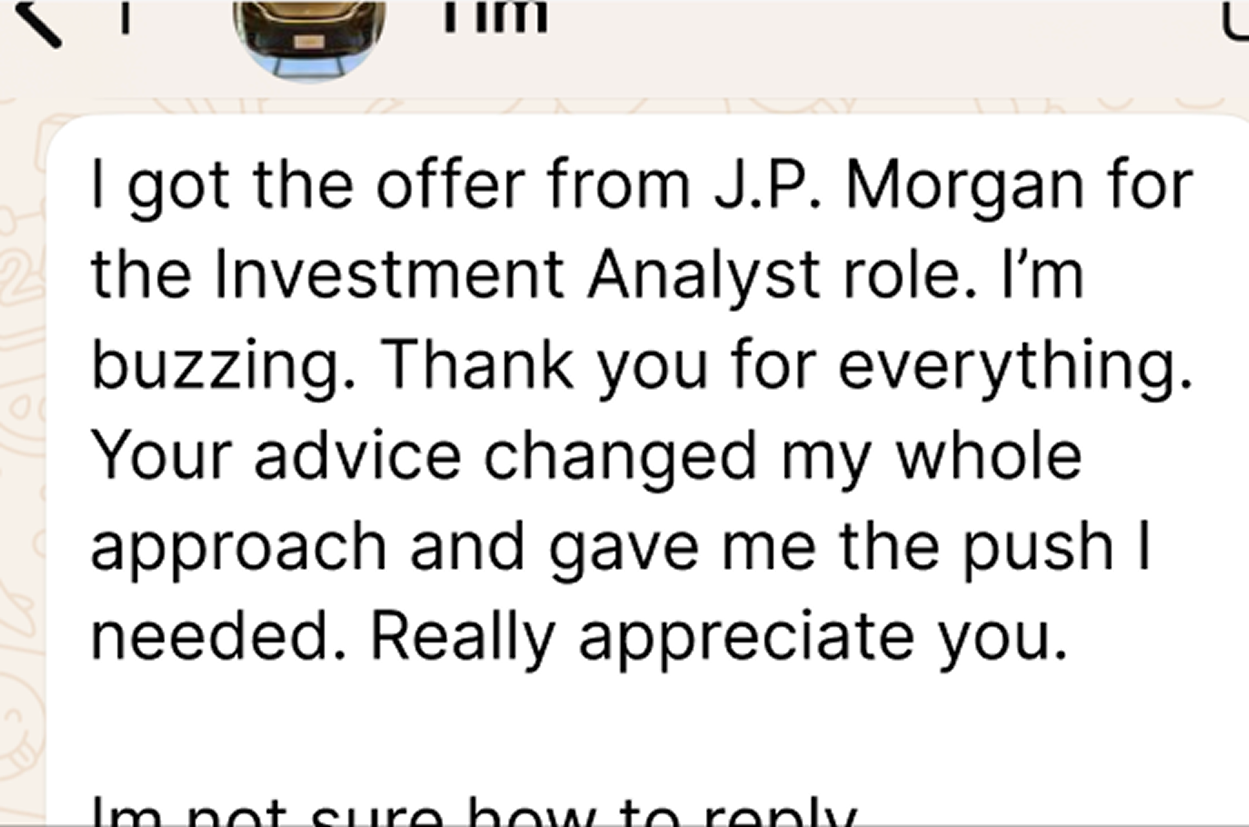
Tim is one of hundreds of candidates inside the free community working on early-career applications to top employers right now. Get access for free.
So, why is it so hard to get a job in 2026?
Because the market got slower, a chunk of the listings are not real, and the old advice to simply apply to more is now actively working against you. The 108-day timeline and the fake-posting noise are not your fault. What you can control is where you point your effort.
Stop measuring your week by application count. Pick one role, get warm before you apply, and put a strong core CV behind it. That is the whole shift, and it is the same shift behind every result I see.
If that is where you are stuck right now, you do not have to work it out alone. Join the free community, where hundreds of other candidates are working on early-career applications to top employers and comparing what is actually landing interviews in this market. Join for free.
Frequently Asked Questions
Why is it taking so long to get a job in 2026?
The market slowed sharply. Huntr's Q1 2026 data puts the median search at 108 days from first application to offer, up 30% from 83 days a quarter earlier, with a median of 29 days just to reach a first interview. If you have been applying for a month with no interview, you are on the median, not behind it.
Are fake job postings really that common?
Yes. In the Q1 2026 survey, 93% of job seekers said they had applied to a posting they suspected was fake, 72% had hit an outright scam, and only 1% completely trust online listings. A real share of your silence is roles that were never genuinely open, which is another reason high-volume applying is a poor strategy.
Does applying to more jobs improve my chances?
No, and the data is blunt about it. Applications in the 11 to 20 range convert at 9.25% each, while past 100 applications it drops to 2.58%. 65% of successful searches finished within 50 applications. Targeting a smaller number of well-matched roles beats spraying the market every time.
Is AI really rejecting my applications?
Two-thirds of job seekers believe AI rejected them at some point, and screening is more automated than it was. But applicant tracking software does not auto-bin your CV with a secret score; a human still reads the shortlist. The reliable way through more automated screening is a warm application, where someone inside the company already knows you have applied.