NatWest Video Interview Questions (2026): What to Expect and How to Answer Them
Key Takeaways
- The NatWest video interview is a one-way, pre-recorded interview. There is no live interviewer. You record your answers and a recruiter watches them later.
- You get around 6 to 7 questions in total. Usually 1 warm-up question and 5 to 6 formal questions covering motivational, competency, and scenario themes.
- You typically get 2 minutes to prepare and 2 to 3 minutes to record each answer. One attempt per question on most setups.
- Questions split into three groups: "why NatWest" and motivation, STAR-based competency questions (teamwork, leadership, problem-solving), and situational scenarios tied to NatWest's purpose.
- Specificity is what passes you. Generic "I want to work in banking" answers fail. Naming a NatWest product, the Group's purpose, or a recent news story is what moves you to the assessment centre.
The NatWest video interview is the stage that filters most candidates out of the early-careers application process. If you have just been invited to record one, this guide gives you the format, the questions you will face, and the exact way to answer each one.
What is the NatWest video interview?
After you pass the online tests (situational judgement, numerical reasoning, logical reasoning), NatWest sends you an email inviting you to complete a video interview. The format is one-way and pre-recorded, which means you log in to a platform, the system shows you a question on screen, a preparation timer starts, then a recording timer starts and you answer to the camera.
There is no person on the other side while you record. Your answers are reviewed later by a NatWest recruiter, sometimes with AI assistance that flags keywords or behavioural signals but does not score you. The myth that the platform reads your facial expressions or tone is wrong. What gets evaluated is the substance and structure of your answer.
NatWest video interview format breakdown
| Detail | Info |
|---|---|
| Format | One-way, pre-recorded |
| Number of questions | 6 to 7 (1 warm-up + 5 to 6 formal) |
| Preparation time | Around 2 minutes per question |
| Recording time | 2 to 3 minutes per answer |
| Attempts | Usually 1 attempt per question |
| Total length | Around 30 to 40 minutes |
| Deadline | Typically 5 to 7 days from invitation email |
| Live interviewer | None |
Once you start the session, you complete it in one sitting. Do not begin until you have a quiet space, working camera and microphone, and 45 uninterrupted minutes.
NatWest video interview questions
The questions rotate by intake, but the three groups stay consistent. Expect roughly two from each group across your set.
Motivational questions
These test whether you have done your research and whether you would actually take the offer if extended. Expect at least one of:
- Why do you want to work for NatWest?
- Why this division or business area at NatWest?
- Why banking, and why now?
- Tell us about yourself and your background.
- What skills or experiences make you suitable for this role?
Competency questions
These are STAR or CCARR questions about your past behaviour. Expect at least two of:
- Tell me about a time you worked in a team to achieve a goal.
- Describe a situation where you demonstrated leadership.
- Tell me about a time you solved a problem under pressure.
- Give me an example of a time you persevered through a setback.
- Tell me about a time you received difficult feedback.
- Describe a time you managed a tight deadline.
Situational and scenario questions
These ask how you would handle a workplace situation, often tied to NatWest's purpose ("we champion potential, helping people, families and businesses to thrive"). Expect one or two of:
- A team member is missing deadlines and slowing the project down. What do you do?
- A customer is unhappy with a decision you cannot change. How do you handle the conversation?
- Discuss a recent news story or technological development and its impact on the banking industry.
- If your manager gives you a task you are unsure how to start, what steps do you take?
How to answer each NatWest video interview question type
Answering "Why NatWest?"
Most candidates open with size or reputation. "NatWest is one of the biggest banks in the UK." That answer applies to Barclays, HSBC, and Lloyds too, which is why it fails.
A strong answer names two specific things about NatWest, explains why each one matters to you, and connects it to your direction. Specifics that work:
- Purpose-led strategy. NatWest's stated purpose is helping people, families, and businesses to thrive. The bank has put commercial backing behind it through the climate transition fund, support for women-led businesses, and the Group's commitment to UK SMEs.
- Cushion and Mettle. NatWest's digital banking propositions (Cushion for support, Mettle for sole traders) show how the Group is building beyond the traditional retail bank model.
- Coutts and NatWest Markets. If you are applying to private banking or markets, naming the specific subsidiary signals you understand the structure of the Group, not just the high-street brand.
- Edinburgh and Manchester hubs. NatWest runs a distributed model across the UK rather than a single London headquarters. If you have a regional connection, this is a concrete reason to apply that competitors do not match.
Pick two of these. Connect each one to a course, a project, an internship, or a piece of news you have followed. Aim for 90 seconds.
Answering the competency questions (CCARR)
The framework that works for video interviews is CCARR. Context, Challenge, Action, Result, Reflection.
- Context. One sentence on where this happened. Internship, society, sports team, work experience.
- Challenge. One sentence on the specific problem you faced. Make it concrete, not abstract.
- Action. Two to three sentences on what you actually did. Use "I" not "we." NatWest wants to assess you, not your team.
- Result. One sentence on the measurable outcome. Numbers if you have them. "Doubled sign-ups" beats "made a real impact."
- Reflection. One sentence on what you learned and would do again.
Worked example for "Tell me about a time you solved a problem under pressure":
Context: I was treasurer for my university finance society, which ran a flagship Insight Day for 150 attendees. Challenge: Two weeks before the event, our headline speaker cancelled and we were at risk of losing 40 sign-ups who had registered specifically to hear them. Action: I drafted a shortlist of three alternative speakers, used a contact from my summer internship to make a warm introduction, and confirmed a replacement within four days. I then sent every registered attendee a personal email explaining the change and what they would still get from the day. Result: We kept 38 of the 40 at-risk attendees and the event ran with a full room. Reflection: I learned that a fast, transparent communication beats a perfect plan delivered late.
Run timed practice with this structure. Aim for 2 minutes total, not 3.
Answering the situational and scenario questions
These are not asking what you would do in theory. They are asking how your judgement aligns with NatWest's purpose and values. Before recording, read NatWest's published values on their careers site so you have a frame to anchor any scenario answer.
For example, on the "team member missing deadlines" scenario:
I would have a private one-to-one with them first, not raise it in the group. I would ask if something is going on outside the project that is affecting their work, because in my experience most missed deadlines are a sign of a wider problem rather than carelessness. Then I would agree a clear plan together to catch up, and only escalate to a manager if the same issue happens twice. That approach reflects the curious and inclusive tone NatWest sets across its careers content, which is why I would default to it rather than going straight to escalation.
You are showing judgement, empathy, and an understanding of NatWest's stated values. That combination is what the recruiter is looking for.
Hundreds of candidates inside the free community are working on early-career banking applications at NatWest and other Tier 1 UK banks right now. Join them for free.
Proof this approach works
This is the same structure Tim used when he was applying into banking.
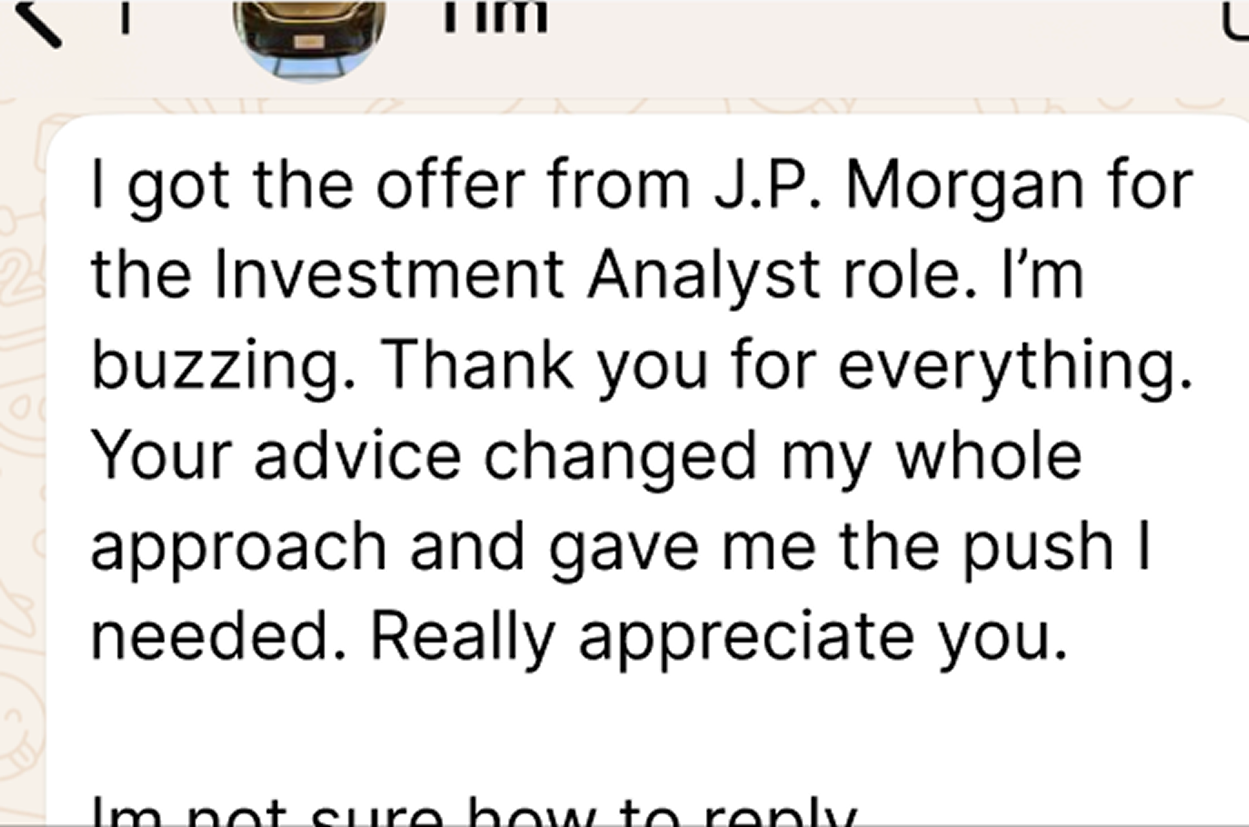
Tim is one of hundreds of candidates inside the free community working on early-career banking applications at NatWest and other Tier 1 UK banks. Join them for free.
Preparation strategy
5 days before
- Re-read the NatWest careers page for your specific programme. Note the language they use about the role and the purpose statement.
- Pull together six CCARR stories from your last two to three years. Cover teamwork, leadership, problem-solving, perseverance, conflict, and tight-deadline situations. One story can be used for two questions if framed differently.
- Pick a current banking news story you can defend. UK base rate, ring-fencing, open banking, the rise of digital-only competitors, NatWest's own results. Avoid stories you cannot explain at a technical level.
2 days before
- Run a full mock recording on your phone. Use the timer. 2 minutes prep, 2.5 minutes answer. Watch the playback. Check three things: eye contact with the camera lens (not the screen), filler words, and whether your answer actually has a Result.
- Test your laptop camera, microphone, and internet connection in the exact room you plan to use.
On the day
- Dress smartly from the waist up. Plain dark top works best on camera.
- Use a quiet, well-lit space. Window in front of you, not behind. Camera at eye level.
- Have a bullet-point cheat sheet of CCARR story prompts on a notepad just below your camera. Names and one-word labels only. Do not write full sentences and do not read while recording.
- Close every other tab and silence notifications.
- Smile briefly at the start of each answer. It reads as warmth and steadies your voice.
Common mistakes that fail the NatWest video interview
Reading from a script. The platform is forgiving on minor stumbles. It is not forgiving on flat, robotic delivery. Your answers should be structured but spoken, not read.
Generic motivation. Saying you want to work at NatWest because it is "a leading UK bank" or "has great training" applies to every competitor. Name specific products, regions, or initiatives.
No Result in competency answers. Most candidates explain the situation and the action, then trail off. The Result is what proves the story is real and matters. Always include a number, an outcome, or a measurable change.
Rambling to fill the time. Three minutes is a maximum, not a target. Tight 2-minute answers consistently outperform 3-minute ones.
Ignoring the situational questions. Candidates over-prepare for competency questions and freeze on the scenarios. Read NatWest's values before the session so you have a frame to anchor any scenario answer.
Poor technical setup. Background noise, low lighting, and a camera pointing up your nose all damage your impression before you say a word. Spend 10 minutes the day before testing your setup.
Related guides
- NatWest Group Banking application process
- Agency Banking Lead at NatWest Group application process
- BlackRock Virtual Cover Letter: What It Is, Questions Asked, and How to Pass It
What to do next
If you have been getting through the NatWest online tests but stalling at the video interview, the fix is rarely one better answer. It is usually the structure of every answer, the specificity of your motivation, and how you handle the timed pressure.
Join the free community with hundreds of other candidates working on early-career banking applications at NatWest and other Tier 1 UK banks right now. Join for free.
Frequently Asked Questions
How long is the NatWest video interview?
The full session usually takes 30 to 40 minutes. You get around 2 minutes to prepare each question and 2 to 3 minutes to record your answer. Plan for 45 minutes of uninterrupted time including setup.
How many questions does NatWest ask in the video interview?
Most candidates report 6 to 7 questions in total. There is usually 1 warm-up question, then 5 or 6 formal questions covering motivation, competency, and scenarios.
Can I retake my answers on the NatWest video interview?
On most NatWest setups you get a single attempt per question. The platform may allow a short re-record before you submit each answer, but this is not guaranteed. Treat every recording as your final answer.
Does NatWest use HireVue for its video interview?
NatWest has used HireVue and other one-way video platforms across different intakes. The exact provider depends on your application cycle. The format and the question types are very similar regardless of provider.
How long does it take to hear back from NatWest after the video interview?
Most candidates hear back within one to two weeks. The next stage is usually the virtual assessment centre, which includes a group exercise, a written or case task, and a one-to-one competency interview.