Lazard HireVue Questions (2026): What to Expect and How to Answer Them
Key Takeaways
- The Lazard HireVue is a pre-recorded video interview with around 5 questions. You get roughly 30 seconds to prepare and 1.5 to 3 minutes to record each answer.
- Questions are motivational and situational. There are no technical questions, no brain teasers, and no live interviewer reacting on the other end.
- The HireVue sits after the online application and situational judgement test, and before the final live interview. Expect a wait of around 1 to 2 months for the outcome on the Spring Intern Analyst process, and roughly 1 week on the Spring Intern process.
- Lazard is explicitly looking for personable candidates. The unspoken question behind every prompt is "would I want to sit next to this person for 12 hours a day."
- The single biggest reason candidates fail the HireVue is sounding rehearsed. Memorised answers are obvious on camera and they read as inauthentic.
The Lazard HireVue is the stage where the firm decides whether you are interesting enough to put in front of a real banker. By this point you have already passed the CV screen and the situational judgement test, and the candidates left in the pool look broadly similar on paper. What separates the people who progress from the people who get the polite rejection is a 20 to 30-minute pre-recorded video that rewards a very specific kind of preparation.
This guide breaks down exactly what to expect from the Lazard HireVue questions, the answer framework that consistently produces strong recordings, and the mistakes that filter most candidates out before a human ever reviews them.
What is the Lazard HireVue?
The Lazard HireVue is a pre-recorded video interview hosted on the HireVue platform. You receive a link by email, log in when you are ready, and the system walks you through an introduction video followed by 5 questions delivered as short pre-recorded clips. You have around 30 seconds to prepare each answer and between 1.5 and 3 minutes to record your response.
The interview is grouped under Financial Advisory and is not division specific. Whether you are applying for the Spring Intern or the Spring Intern Analyst programme, the HireVue covers the same broad ground: why you want to be there, how you think, and whether you can hold a conversation.
Format at a glance
| Detail | Info |
|---|---|
| Format | Pre-recorded video, HireVue platform |
| Number of questions | Around 5 |
| Prep time per question | Roughly 30 seconds |
| Answer time per question | 1.5 to 3 minutes |
| Question types | Motivational and situational only |
| Wait for outcome | 1 to 2 months (Analyst), around 1 week (Intern) |
| Re-records | Usually 1 to 2 per question on most setups |
What is consistent across both Lazard programmes is the assessment intent. The HireVue is the moment Lazard checks whether the way you talk about yourself matches the CV you submitted, and whether you sound like someone the team would actually want to spend time with.
Lazard HireVue questions you should prepare for
These are the questions and prompt types reported by candidates who have been through the Lazard HireVue in the last 2 years, pulled from vault employer guides and public sources. Treat the exact wording as illustrative; Lazard rotates phrasings between intakes.
Motivational questions:
- Why did you apply for Lazard?
- Why financial advisory?
- What do you hope to gain from the Spring Week at Lazard?
- How would you describe Lazard to someone who does not know what investment banking is?
- Why this division, this firm, this year?
Situational and competency questions:
- Tell us about a time you worked in a team.
- Tell us about a time you demonstrated leadership.
- Describe a time you had a difficult team member and how you dealt with that.
- How would you approach a high-level M&A deal you were asked to support on?
- Tell us about a recent news story or article that interested you.
Conversational and personality prompts:
- If money was not an issue, what would you do for a living?
- If you could have dinner with anyone, dead or alive, who would you pick and why?
- What is something outside of work that you are genuinely good at?
Notice what is missing from this list. No DCF walkthroughs. No 3-statement linking. No accounting questions. No brain teasers. Lazard pushes the technical depth to the final interview with the junior banker. The HireVue is purely about motivation, judgement, and personality.
How to answer each question type
Motivational questions
The single highest-stakes question on the entire HireVue is "Why Lazard." A weak answer points to reputation, prestige, or training. A strong answer points to a specific deal Lazard has run, a banker you have spoken to, a sector commitment, or a structural reason Lazard fits where you want to go.
The fix is research before the recording. Read the most recent Lazard press releases. Pick one deal or commentary piece from the last 6 months that you can speak about for 30 seconds. Connect it to your own background or your reason for choosing financial advisory specifically over sales and trading, asset management, or consulting. Name the deal, name the rationale, name the reason it caught your eye.
For "Why financial advisory," do not describe it as a stepping stone. Lazard knows that for many candidates the Spring Week is exactly that. The candidates who progress give a reason rooted in the work itself: the variety of mandates, the small deal teams, the exposure to executive decision-making.
For the "describe Lazard to a non-banker" question, the test is whether you can explain something complex in plain language. Avoid jargon. A clean 3-sentence answer beats a 2-minute one. Try: Lazard advises governments, large companies, and asset managers on the biggest decisions they have to make about money. That includes who to buy, who to sell to, and how to raise the cash to do it. It is one of the oldest independent advisory firms in the world.
Situational and competency questions
Use the CCARR framework: Context, Challenge, Action, Result, Reflection. The same structure that works for live competency interviews works for HireVue, with one adjustment. The 3-minute timer creates artificial pressure to fill the time, and most candidates over-fill it.
Aim for 2 to 2.5 minutes per answer. Tight answers consistently outperform rambling ones. The interviewer reviewing the recording is watching dozens in a sitting; they will reward structure and clarity over volume.
A worked example using CCARR for "Tell us about a time you worked in a team":
Context: At university I co-led a 6-person team running a charity fundraising event with a 2-week deadline. Challenge: 2 weeks in, ticket sales had stalled at 30% of target and the team was losing momentum. Action: I split the team into 2 pairs, gave each pair a single channel to own, and built a daily 15-minute stand-up to surface blockers early. Result: We hit 110% of the ticket target and raised £4,200, the largest the event had ever generated. Reflection: I learned that loose accountability kills momentum more than a hard deadline does, and that breaking a problem into smaller owned pieces is usually faster than a single group push.
That is roughly 90 seconds delivered at a natural pace. It is structured, specific, and ends with a takeaway. Lazard is not looking for heroics; they are looking for evidence that you think clearly about your own experience.
For the "difficult team member" prompt, do not pick a villain story. Pick something where you genuinely had to work through a disagreement and walked away with a working relationship. The reflection at the end matters more than the conflict itself.
For "tell us about a news story," pick a story you can connect back to financial advisory or to a Lazard sector strength. A piece on the M&A market, a regulatory change affecting one of Lazard's client industries, or a deal involving an independent advisory firm all work. A generic "I read about AI" answer does not.
Hundreds of candidates inside the free community are working on spring week applications at Tier 1 banks like Lazard right now. Join them for free.
Conversational and personality prompts
The conversational questions are where Lazard tests the personable side they value so highly. There is a temptation to play it safe. Resist it.
For "If money was not an issue, what would you do," do not say "the same thing I am doing now, financial advisory." It is obviously rehearsed and it tells the reviewer nothing. Pick something genuinely true about you. A hobby you would scale up, a problem you would try to solve, a place you would spend time. Then link it back briefly to a trait that also makes you good at the role.
For the dinner guest question, do not pick a generic answer like Steve Jobs or Winston Churchill. Pick someone you can actually talk about for 90 seconds with a clear reason. The reviewer wants to see how your mind works, not who is on the standard list.
How to record a HireVue that does not sound rehearsed
The most common reason Lazard rejects HireVue candidates is rehearsed delivery. Memorised answers are obvious on camera. They sound flat, the eye contact drifts, and the breathing pattern gives it away.
The fix is preparation by structure, not by script. Have your CCARR stories sketched out. Know which 3 to 4 motivational hooks you will reuse across the "why Lazard" and "why financial advisory" questions. Know the news story you will reference. Then deliver them naturally, in your own words, the way you would explain them to a friend.
Set up properly. Quiet room. Neutral background. Camera at eye level, not pointing up at your chin. Reasonable lighting from in front of you, not behind. Smart casual or business attire; a shirt is fine for the HireVue, you do not need a tie. Test your microphone before you start the real session.
Use the 30 seconds of prep deliberately. Sketch the structure on paper. Pick the story. Mark the CCARR beats. Do not write a script. The answer should sound conversational, not read.
If you flub a take, use the re-record sparingly. The first take is almost always the most natural. Re-recorded answers tend to sound more rehearsed than the original, because by the second attempt you are unconsciously copying yourself.
Alexia rewired how she presented herself in finance applications and landed her dream finance job in London
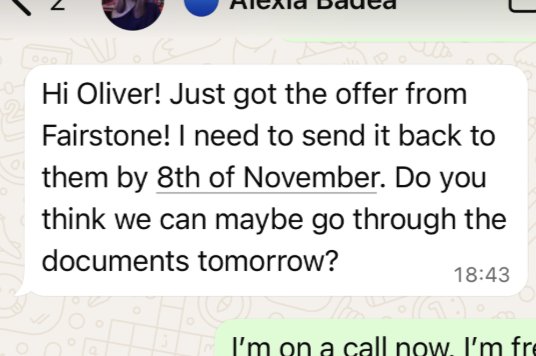
Alexia is one of hundreds of candidates inside the free community working on spring week applications at Tier 1 banks like Lazard right now. Join them for free.
Common mistakes on the Lazard HireVue
The candidates who fail the HireVue tend to make the same handful of mistakes. Avoiding them puts you ahead of most of the pool.
- Reading from a script. The eye drift is obvious on camera, the voice flattens, and the reviewer marks you down within 20 seconds.
- Generic "Why Lazard" answer. If your answer would work for Rothschild or Evercore with a name swap, it is too generic. Name a deal or a sector commitment.
- Filling the full 3 minutes. Tight, structured answers beat long ones. Stop when the story is done.
- Choosing a safe news story. "I read about AI" tells the reviewer nothing. Pick something with a real connection to financial advisory.
- Treating the conversational questions as throwaway. The dinner guest and "if money was not an issue" questions are where Lazard reads your personality. Underpreparing them is a fast way to fail.
- Bad setup. Dim lighting, a noisy background, or a camera pointed at the ceiling makes you look careless before you have said a word.
Related guides
- Spring Intern at Lazard application process guide
- Spring Intern Analyst at Lazard application process guide
- NatWest Video Interview Questions (2026)
If you are getting to the HireVue stage and stopping there, the fix is rarely another practice run
If you are passing the CV and SJT at Lazard and Tier 1 finance firms and the HireVue is where the process keeps ending, the answer is rarely cramming more questions the night before. By HireVue stage you are competing against candidates who all know the basic frameworks. What separates progressions from rejections is how naturally you come across on camera, how specific your motivations are, and whether the answers sound like you or like a template.
Join the free community with hundreds of other candidates working on spring week applications at Tier 1 banks right now. Join for free.
Frequently Asked Questions
How many questions are on the Lazard HireVue?
The Lazard HireVue has around 5 questions. Each one is delivered as a short pre-recorded clip. You get roughly 30 seconds to prepare and between 1.5 and 3 minutes to record your answer. The full session usually takes 20 to 30 minutes from start to finish, including the platform's introduction video and any system checks at the beginning.
What kind of questions does Lazard ask in the HireVue?
Lazard asks motivational and situational questions only. There are no technical questions, no brain teasers, and no accounting questions on the HireVue itself. Expect prompts on why you applied to Lazard, why financial advisory, how you would describe the firm in plain language, a team or leadership story, and a recent news article that interested you. The technical depth is saved for the final live interview with a junior banker.
How long should my Lazard HireVue answers be?
Aim for 2 to 2.5 minutes per answer, even though the platform usually gives you 3. Tight, structured answers consistently outperform long ones. The reviewer is watching dozens of recordings in a sitting and rewards clarity and structure over volume. Rambling to fill the time is one of the most common reasons candidates get filtered out at this stage.
How long does Lazard take to respond after the HireVue?
The wait depends on the programme. Candidates on the Spring Intern Analyst process report waits of 1 to 2 months between the HireVue and the final interview, because the firm batches recordings before review. Candidates on the Spring Intern process report a faster turnaround of around 1 week. Use the wait to research recent Lazard deals, build a shortlist of questions for the final interview, and rest your delivery.
Can I re-record a Lazard HireVue answer?
Most HireVue setups allow 1 or 2 re-records per question, though this varies by intake. Use re-records sparingly. The first take is almost always the most natural; re-recorded answers tend to sound more rehearsed because by the second attempt you are unconsciously copying your earlier delivery. If your first take is good enough, move on.