J.P. Morgan Assessment Centre (2026): Format, Questions, and How to Pass It
Key Takeaways
- The J.P. Morgan assessment centre is roughly 2 hours long and includes 3 distinct sections: a 15-minute presentation, a 25-minute technical interview, and a more relaxed conversational interview.
- You receive your presentation topic by email about 24 hours before the assessment centre, with a small choice of topics such as "the greatest invention of the past 100 years" or "a person you admire."
- The technical interview is rapid-fire. Expect a new question every 1 to 2 minutes covering finance, markets, and concepts relevant to the role.
- The conversational interview tests fit, motivation, and values. "Why J.P. Morgan?" is asked in some form at almost every assessment centre.
- The assessment centre sits in the Investment Banking, Wealth Management, and full-time entry-level processes. Spring week candidates usually do not face a full AC. The format and the questions are similar across business areas.
The J.P. Morgan assessment centre is the stage where most candidates stop progressing. By this point you have already passed the CV screen and the HireVue, and the candidates left in the room are all qualified on paper. What separates the people who get offers from the people who get the polite rejection email is how they handle 2 hours of presentation, technical questioning, and a final conversational interview.
This guide breaks down exactly what to expect at the J.P. Morgan assessment centre, the questions you will face at each stage, and how to prepare so you do not get filtered with the people who walked in unprepared.
What is the J.P. Morgan assessment centre?
The J.P. Morgan assessment centre is the final filter before an offer. It usually runs around 2 hours, either virtually or at the J.P. Morgan office in Canary Wharf depending on the programme and the year.
Different J.P. Morgan programmes structure the day slightly differently. Wealth Management candidates report a 3-part format: a 15-minute presentation, a 25-minute technical interview, and a more conversational fit interview. Investment Banking candidates report 3 separate interviews instead, covering competencies, technical knowledge, and commercial awareness. The Spring Week process is shorter and usually skips the full AC entirely.
What is consistent is the assessment criteria. J.P. Morgan is testing whether you can present an idea clearly, hold your own under technical pressure, and have a genuine, specific reason for wanting to work there.
Assessment centre format
| Detail | Info |
|---|---|
| Total length | Around 2 hours |
| Format | In-person at Canary Wharf or virtual, depending on programme |
| Sections | Presentation, technical interview, conversational interview |
| Notice for presentation | Roughly 24 hours before the AC |
| Wait for outcome | Up to 1 week |
| Conversion rate | The AC is the highest-stakes filter in the process |
Once you receive the AC invitation, the clock starts on your presentation prep. You will not get more than a day, and the topic email arrives without warning.
Stage 1: The presentation
You receive an email about 24 hours before the assessment centre with a short list of topics. Common topics reported by candidates include "the greatest invention of the past 100 years" or "a person you admire." You pick one and prepare a 15-minute presentation, followed by questions from the interviewers.
This is the part of the AC most candidates underestimate. 15 minutes is a long time to hold attention, the interviewers will interrupt with questions, and they are watching for clarity of thinking as much as content.
How to prepare the presentation
Pick a topic you have a real point of view on. The candidate who presents on "the printing press" because it feels safe will lose to the candidate who picks something niche and explains it well. Specificity beats safe.
Build your presentation around a clear structure. Open with the claim you are making. Lay out 3 supporting points. Anticipate the obvious counter-argument and address it. Close with the implication for J.P. Morgan, the industry, or the world.
Slides should be minimal. Bullet points only as anchors. The talking is your job, not the deck's. Practise the full 15 minutes out loud at least twice before the AC. Time yourself. Most candidates run over because they have not actually rehearsed.
Prepare for questions before you finish your slides. The interviewers will probe your reasoning, especially the weak point in your argument. Have a thoughtful answer ready for the obvious objections.
The free community is where hundreds of people working on Tier 1 finance applications swap notes on what is coming up at AC stage right now. Join for free.
Stage 2: The technical interview
The technical interview is 25 minutes, rapid-fire. Expect a new question every 1 to 2 minutes. The interviewer is not looking for textbook answers. They are looking at how you think when you do not know the answer immediately.
Reported questions cover a broad surface area. Examples from candidates who have been through the J.P. Morgan AC:
- If you had $10 million to invest in ETFs, what would you do?
- Describe what a spread is.
- Why do we discount cash flows in a DCF analysis?
- Walk me through an LBO.
- How are the 3 accounting statements linked?
- How do interest rate changes affect a bank's balance sheet?
- Tell me about a current news story involving J.P. Morgan.
- Describe a time you used both quantitative and qualitative skills to complete a project.
- Discuss recent trends in the Consumer and Retail sector.
- As a business owner, would you prefer to increase profits by raising prices or by increasing sales volume?
How to answer technical questions
Do not panic when you hit a question you cannot answer. The interviewer is testing your thought process more than your knowledge base. Be honest, then walk them through how you would approach it.
For valuation questions like DCF and LBO, know the structure end to end. You should be able to walk through a DCF in 60 seconds without notes. The same for the 3 accounting statements and how they link. These are the questions that come up at almost every finance AC, and getting them wrong is a fast way to fail.
For commercial awareness questions, read the Financial Times daily for the 2 weeks before your AC. Pick 2 stories you can speak about confidently and rehearse how they connect to J.P. Morgan's business areas. If you can name a recent J.P. Morgan deal and explain the rationale, you are ahead of most candidates in the room.
For brain-teaser style questions, talk out loud as you work through them. The interviewer wants to see structured thinking, not silence followed by a guess.
Stage 3: The conversational interview
The conversational interview is the most relaxed part of the day. It usually lasts 20 to 30 minutes and focuses on motivation, fit, and values. Despite the name, this is where most weak candidates fall over because they have a generic answer to the question that matters most: "Why J.P. Morgan?"
Common questions reported:
- Why J.P. Morgan?
- Why this particular division?
- How do you fit into J.P. Morgan?
- What are the core principles and values of J.P. Morgan? Do you align with them?
- Tell me about a time you worked in a team.
- Describe a time you balanced competing priorities.
- What is an achievement you are proud of?
- What is your biggest weakness, and how do you turn it into a strength?
- Why should we hire you?
How to answer the conversational interview questions
The single biggest filter in this section is the "Why J.P. Morgan?" question. A weak answer points to size, prestige, or training schemes. A strong answer points to something specific J.P. Morgan has done that genuinely interests you, a person at the firm you have spoken to, or a concrete reason this firm fits where you are going next.
Generic motivation answers fail because the interviewer has heard them every day for a week. The fix is to research the firm before the AC. Find a recent deal, a piece of leadership content, a podcast appearance, or a public commitment that genuinely caught your attention. Reference it specifically. Connect it to your own background or your reason for applying.
For competency questions, use the CCARR framework: Context, Challenge, Action, Result, Reflection. STAR also works. The point is to give a structured answer with a specific outcome at the end, not a vague description of a project.
Ask thoughtful questions at the end. "What is the biggest challenge in your role right now?" or "How does J.P. Morgan think about the integration of AI into your division?" beats "What is the culture like?"
Tim joined the free community after 200+ applications and 0 offers. 6 weeks later he was an analyst at J.P. Morgan.
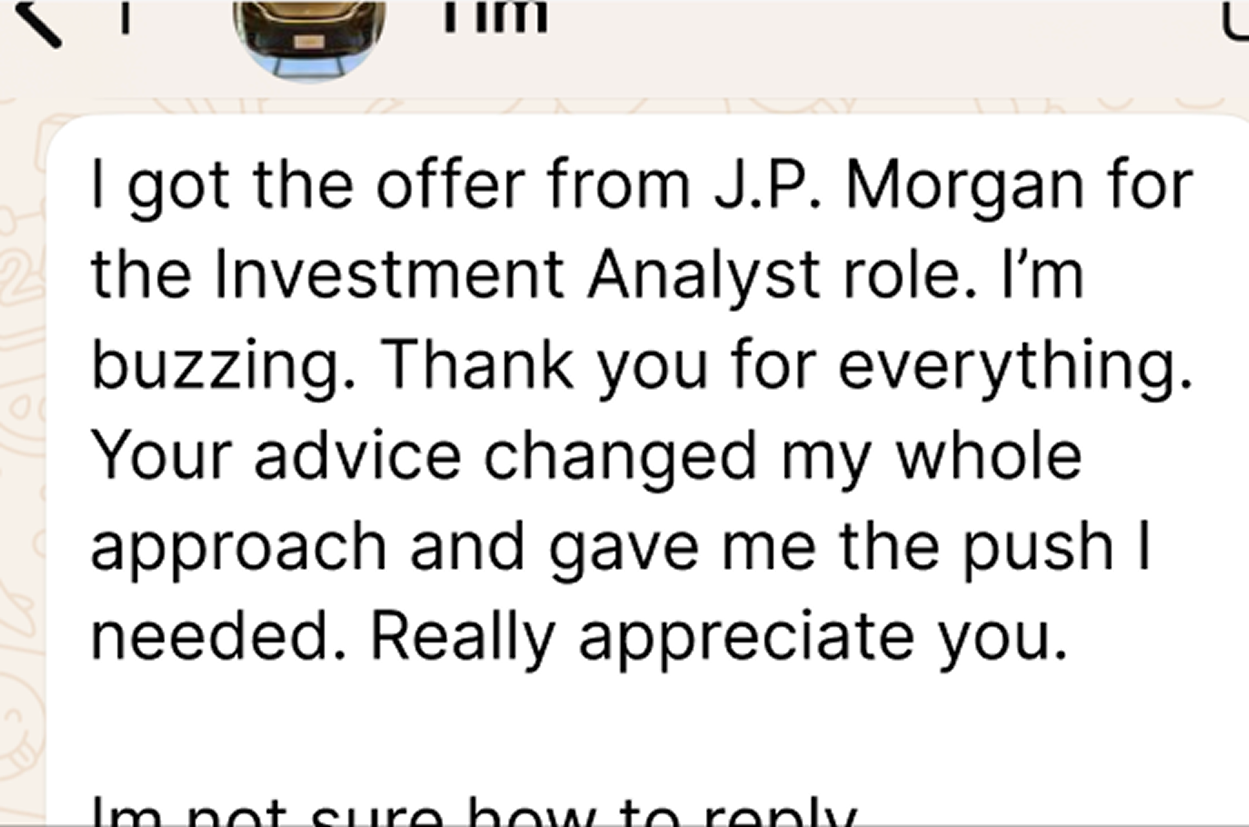
Tim is one of hundreds of candidates inside the free community working on Tier 1 finance applications right now. Join them for free.
Common mistakes at the J.P. Morgan assessment centre
The candidates who fail the AC tend to make the same handful of mistakes. Avoiding these puts you ahead of most of the room.
- Generic "Why J.P. Morgan?" answer. If your answer would work for Goldman Sachs or Morgan Stanley with a name swap, it is too generic. Find something specific.
- Reading slides during the presentation. The slides are an anchor, not a script. The interviewers want to see you talk.
- Bluffing on technical questions. If you do not know, say so, then walk through how you would think about it. Bluffing gets caught immediately.
- No questions at the end. "I do not have any questions" reads as low interest. Always have 2 thoughtful questions prepared.
- Forgetting the firm's recent news. You should be able to name a J.P. Morgan deal or strategic move from the last quarter.
- Underpreparing because the conversational interview "feels relaxed." It is the section where most offers are decided.
Related guides
- How to Write a Cover Letter for J.P. Morgan
- J.P. Morgan Spring Week 2026: Application Process and HireVue Questions
- BlackRock Virtual Cover Letter: What It Is, Questions Asked, and How to Pass It
If you are getting to assessment centres and stopping there, the problem is rarely the questions
If you are applying to J.P. Morgan and Tier 1 finance firms and the assessment centre is where you keep getting filtered, the fix is rarely cramming more technical knowledge the night before. By AC stage you are competing against candidates who all know the DCF. What separates offers from rejections is preparation depth, specificity in your "why" answers, and the structured thinking the firm is actually testing for.
Join the free community with hundreds of other candidates working on Tier 1 finance applications right now. Join for free.
Frequently Asked Questions
How long is the J.P. Morgan assessment centre?
The J.P. Morgan assessment centre runs around 2 hours from start to finish. It includes a 15-minute presentation, a 25-minute technical interview, and a 20 to 30-minute conversational interview. Some divisions structure the day as 3 separate interviews rather than a presentation plus interviews. The format depends on the programme and business area you are applying to.
What presentation topics does J.P. Morgan give at the assessment centre?
J.P. Morgan sends presentation topics around 24 hours before the assessment centre. Reported topics include "the greatest invention of the past 100 years," "a person you admire," and similar open-ended prompts where you pick from a small list. You get 15 minutes to present, followed by questions from the interviewers. Slides are expected to be minimal.
How hard are the J.P. Morgan assessment centre technical questions?
The technical questions cover a broad surface area: DCF and LBO walkthroughs, the 3 accounting statements and how they link, interest rate transmission, valuation methods, and commercial awareness questions about recent deals. The difficulty is less about the depth of any single question and more about pace. Interviewers move on quickly and are watching how you think under pressure as much as what you know.
What is the J.P. Morgan assessment centre pass rate?
J.P. Morgan does not publish a pass rate for the assessment centre. Based on candidate reports, the AC is the highest-stakes filter in the process, with many qualified candidates falling out here. The single biggest reason for rejection is a generic "Why J.P. Morgan?" answer, followed by underprepared presentations and bluffed technical answers.
How long does J.P. Morgan take to give an outcome after the assessment centre?
Most candidates report a wait of around 1 week between the assessment centre and the outcome. Some divisions move faster, especially when the offer pipeline is closing for a specific intake. Use the wait to send a polite thank-you note to the interviewers and prepare for any final-stage interviews, which still happen in some programmes such as Wealth Management.