Jefferies Investment Banking Internship 2026: Application Process and How to Get In
Key Takeaways
- There are 2 routes into the Jefferies investment banking internship: the Spring Insight Programme (1 week, for first-year candidates) and the Summer Analyst Programme (10 weeks, for penultimate-year candidates).
- Both routes run through the same 3 application stages: online application with a CV and division motivation, an SHL online assessment, and a video or phone interview. Summer Analyst finalists also sit a 60-minute modelling test on superday.
- Jefferies allows you to apply to up to 2 divisions in 1 application. For Investment Banking, the motivation paragraph is the single most important piece of writing in the entire process.
- The SHL Verify G+ assessment is one of the toughest screens in UK banking. It mixes inductive, deductive, and numerical reasoning inside an interactive drag-and-drop interface, not standard multiple choice.
- Jefferies sponsors UK work visas for analyst hires, which is why the programme attracts a high volume of international applicants. That also means non-target international candidates compete directly against target-school UK candidates at every stage.
Jefferies takes roughly 338 interns from more than 25,000 applicants every year across its London office. The Investment Banking internship is one of the most competitive tracks inside that funnel, sitting alongside Equity Research, Markets, and Finance. This guide walks through both routes into Jefferies investment banking as an intern (the 10-week Summer Analyst Programme and the 1-week Spring Insight Programme), the full application stages for each, the SHL test that filters most candidates, and the specific things people who get in tend to do differently.
The 2 routes into Jefferies investment banking as an intern
Most candidates searching for the Jefferies investment banking internship are looking at 1 of 2 programmes. They are very different in length, eligibility, and what they lead to.
| Programme | Who it is for | Length | Converts to |
|---|---|---|---|
| Spring Insight Programme | 1st-year candidates (2nd year if on a 4-year course) | 1 week | Fast-tracked Summer Analyst application |
| Summer Analyst Programme | Penultimate-year candidates and master's-level applicants | 10 weeks | Full-time Investment Banking Analyst offer |
The Spring Insight Programme is your entry point if you are in your first year and want to break into investment banking early. It runs for 1 week in April, covers all 4 divisions, and the strong performers receive fast-tracked Summer Analyst offers for the following year.
The Summer Analyst Programme is the main feeder for the full-time Investment Banking Analyst class. It runs for 10 weeks in the summer, and the conversion rate from intern to full-time offer is typically 70 to 90 percent for strong performers.
If you are picking between the 2, the order is simple: apply to the Spring Insight in your first year if you can, then go for the Summer Analyst Programme in your penultimate year. If you are already past first year, go straight to the Summer Analyst route.
Stage 1: Online application
The online application is the first filter and the hardest one to write well. You submit personal information, education history, employment history, your CV, and a short motivation paragraph for each division you have selected.
Jefferies lets you apply to up to 2 divisions. For most people reading this, that means picking Investment Banking plus 1 other (often Markets or Equity Research). Each division gets its own motivation paragraph, capped at around 200 words, and the form asks you to explain why you want to join that specific division at Jefferies.
The 2 questions you will face inside the application form usually look something like:
- Why do you want to work in Investment Banking at Jefferies?
- Tell us about your greatest achievement and why it sets you apart.
What strong Investment Banking applications do differently
The reviewers are reading hundreds of these in a sitting. They are looking for 3 signals in the 200 words: that you understand what Jefferies Investment Banking actually does, that you have chosen Jefferies deliberately over the bulge brackets, and that something in your background ties to the work.
Specifics that move an application from filtered to forwarded:
- Naming a recent Jefferies deal in the division you are applying to. Their advisory league table position has climbed substantially in the past 3 years; pick something specific from a sector you can speak to
- A clear reason for Jefferies specifically over Goldman Sachs, Morgan Stanley, J.P. Morgan, or the other bulge brackets. The honest answer is usually some combination of deal flow per analyst, sector specialisation (healthcare, technology, energy transition), or middle-market positioning. Use one of those, do not just say "smaller team and more responsibility"
- A piece of your background that connects to deal work: investment society analyst track, a stock pitch, a modelling project on a placement, society treasurer role where you built a budget reconciliation
- A short reference to commercial awareness: a recent M&A trend, equity capital markets activity, or a sector shift you have read about
What does not work: copying generic "I am passionate about finance" language, quoting Jefferies' values back at the firm without applying them, or pasting the same paragraph you wrote for the Markets application.
A useful tactic Oliver coaches inside The Offer Accelerator is to name the source of your interest explicitly. If you watched a presentation by a Jefferies banker on YouTube or spoke to someone at the firm at a careers event, say so by name. The reason Eve was coached to open her J.P. Morgan cover letter with "the reason I am applying for this role is because I watched Stu Kofner's presentation in J.P. Morgan's conversation series" is that it instantly turns a vague alignment claim into a verifiable, specific connection. Apply the same pattern to Jefferies.
Submit your application early in the cycle. Spring Insight applications typically open in November and close once positions are filled. Summer Analyst applications open in September. Jefferies reviews applications on a rolling basis, so HireVue and SHL invites go out before deadlines close.
Expect a 1 to 2 week wait before the SHL invite arrives.
Stage 2: SHL Verify G+ online assessment
The SHL Verify G+ is where most of the application pool gets cut. The assessment is harder than the equivalent tests at most other banks because of 3 things: the interactive drag-and-drop interface, the speed required, and the fact that 3 reasoning types are stacked into a single sitting.
The full assessment takes around 45 to 70 minutes depending on whether the situational judgement test is included as a preceding section. Inside the cognitive ability test itself you face inductive reasoning, deductive reasoning, and numerical reasoning questions back-to-back.
What the questions actually look like
Numerical reasoning involves data from charts and tables: bar charts comparing 2 revenue streams across 2 years, pie charts showing revenue mix, balance sheet extracts. You will be asked to calculate percentage changes, find missing values using equations, and interpret ratios. The maths is GCSE-level. The difficulty is the time pressure and the layered question structure that builds on the same dataset.
Inductive reasoning tests your ability to spot patterns. You are shown sequences of shapes, symbols, or grids and asked to identify the rule and predict the next item.
Deductive reasoning tests your ability to draw logical conclusions from rules. You might be asked to arrange an analyst's diary given a set of constraints, where only one solution satisfies every condition.
How to prepare without wasting time
Most candidates who fail the SHL did not prepare for the right format. They practised generic numerical reasoning on JobTestPrep then walked into Jefferies expecting standard multiple choice. The Jefferies interface is drag-and-drop and the speed is unforgiving.
A few specific moves separate the pass from the fail:
- Take 2 to 3 full SHL Verify G+ practice tests on the SHL practice portal before the real one. Free generic tests will not replicate the format
- Sit the real test in a quiet room with a calculator, scratch paper, and a stable internet connection. Many candidates have lost the test to a Wi-Fi cut, not the questions
- On numerical, read the question before the chart. The chart is dense; reading it cold wastes 20 seconds you do not have
- On deductive, write the constraints out on paper before trying to solve. The rules feel manageable in your head until you are on question 4 of 5
- If you get stuck on a question, mark a sensible answer and move on. Incorrect answers can lower your score on some SHL variants, but unanswered questions definitely do
Expect a 2 to 4 week wait before the interview invite arrives.
Hundreds of candidates inside the free community are working on Jefferies and Tier 1 finance applications right now. Join them for free.
Stage 3: Interview round
The interview format depends on which programme you applied to.
For the Spring Insight Programme, the interview is a 45-minute video interview with a Vice President or senior associate. For the Summer Analyst Programme, the first round is typically a 30-minute phone interview with an analyst from the division you applied to, followed by a superday on-site with multiple back-to-back interviews and (for Investment Banking specifically) a 60-minute modelling test.
What the questions actually look like
Across both programmes, the questions cluster into 4 themes:
Motivation and fit
- Why investment banking?
- Why Jefferies over the bulge brackets?
- Walk me through your CV
- What do you hope to gain from this programme?
Commercial awareness
- What do you do to keep up with financial news?
- Tell me about a recent deal you have been following
- How would you go about finding the perfect stock to invest in?
- What sector interests you most and why?
Behavioural
- Tell me about a time you worked in a team
- Tell me about a time you set yourself a high goal
- Tell me about a time you managed multiple deadlines
- How do you handle constructive criticism?
Technical (Summer Analyst only, deeper on superday)
- Walk me through a DCF
- What are the 3 financial statements and how do they link?
- What is WACC, and how would you calculate it?
- Why might EBITDA be a misleading metric?
- Walk me through how an LBO works at a high level
How to actually answer these in the room
For motivation and fit, the CCARR framework (Context, Challenge, Action, Result, Reflection) gives you a clean answer shape under time pressure. Sketch the 5 beats on paper before you record or join the call. Pick 1 story per question. Mark the beats. Then deliver it conversationally, in your own words, the way you would explain it to a friend. Memorised answers are obvious within 15 seconds; structured answers told naturally beat polished ones every time.
For commercial awareness, the test is not how much you know. It is whether you have an actual view. The candidates who progress have read a sector deeply (energy transition, healthcare biotech, mid-market technology) and can talk about 1 recent deal with a clear opinion on the logic, the price, and what could go wrong. Reading a Financial Times article that morning does not produce that.
For behavioural, prepare 4 to 5 stories that cover the recurring competencies: teamwork, leadership, dealing with conflict, managing competing deadlines, and a time you spotted a problem before it became a bigger one. Coursework, internships, society roles, and part-time work all count.
For technical, get to a working understanding of the 3 statements, DCF mechanics, WACC, and basic LBO logic. Rosenbaum and Pearl's Investment Banking textbook covers all of it. Breaking Into Wall Street's free 101 videos cover the same ground in a few hours.
A real example of what closing the loop looks like
Tim joined The Offer Accelerator after months of getting ghosted and instantly rejected by Tier 1 finance firms. His CV was not landing, the early stages were not opening, and his visa window was closing. Within 6 weeks of joining he had a role at J.P. Morgan.
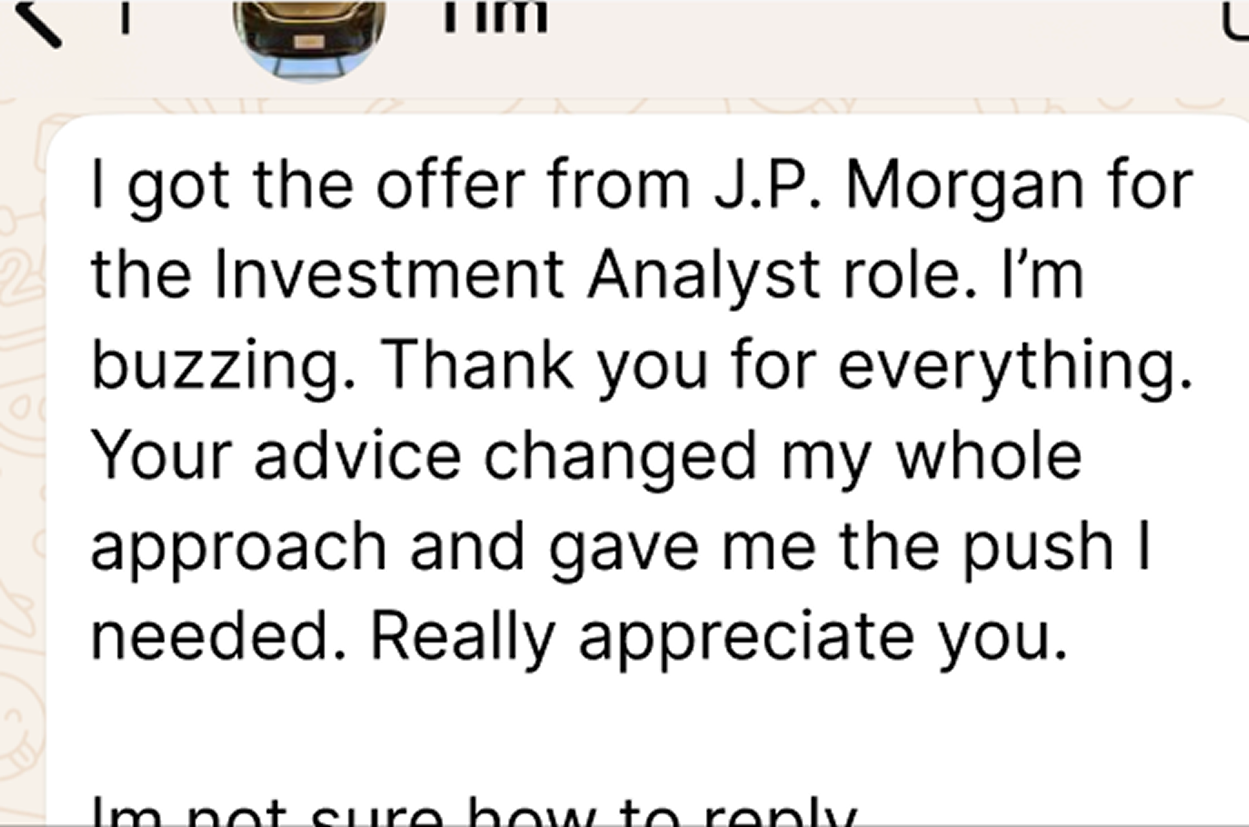
Tim is one of hundreds of candidates inside the free community working on Jefferies and Tier 1 finance applications right now. Join them for free.
Wait time for the interview outcome is typically 1 to 2 weeks for Spring Insight, and up to 2 weeks for Summer Analyst including the superday outcome.
The 60-minute superday modelling test (Investment Banking only)
For Summer Analyst Investment Banking finalists, the superday includes a 60-minute modelling exercise alongside the back-to-back interviews. You are given a short prompt, a spreadsheet template, and asked to build out something like a 3-statement projection, a basic DCF, or a comparable companies analysis.
The test is not looking for a finished Wall Street model. It is looking for 4 things: that you can work in Excel keyboard-first for the basics, that you understand how the 3 statements link, that you can build clean formula references, and that you can put together a sensible answer under pressure.
Practise the night before by building a basic 3-statement model from scratch using a Macabacus or Wall Street Prep template. Speed matters less than structure. Label assumptions clearly, use blue for inputs and black for formulas, and check that your balance sheet balances at the end.
What Jefferies looks for that the bulge brackets do not
Three things tend to come up across vault interview feedback that are more pronounced at Jefferies than the bulge brackets.
The first is genuine commercial interest. Because Jefferies is a smaller team, analysts get exposure to live deal work earlier and the team has less appetite for hires who joined "because it sounded prestigious". A vague "I love finance" answer that might pass at a bulge bracket round 1 will get you cut at Jefferies.
The second is sector or product specificity. Jefferies has built deep specialisation in healthcare, technology, energy, and the middle market. Showing you understand one of those verticals (or one of their lead bankers in it) signals you have done real research.
The third is a candidate who can hold a 30-minute conversation. Jefferies interviewers, especially at the senior end, run more conversational interviews than the structured competency rounds at the bulge brackets. You will not be saved by a script. You will be helped by genuine curiosity, a real view on the market, and the ability to ask interesting follow-up questions back.
Common mistakes across the 3 stages
Candidates who get filtered tend to repeat the same handful of mistakes. Avoiding them puts you ahead of most of the pool.
- Recycling the same motivation paragraph across Investment Banking and the second division. Jefferies sees both. Pick 1 division you really want, write 1 sharp paragraph for it, and only do a second if you genuinely want it
- Practising the SHL with generic numerical tests instead of the actual SHL Verify G+ practice portal. The interface alone catches most candidates out
- Walking into the phone interview without a single concrete view on a recent deal, sector, or market move. Reading the morning Financial Times is not preparation
- Treating the technical questions as a memorisation exercise. Interviewers can spot rote recall instantly. State what you know, narrate how you would think about the rest, and ask sensible clarifying questions
- Underprepping for the modelling test on superday because the interview took priority. A bad model in a strong superday round will sink the offer
- Forgetting that everyone on superday is part of the assessment. Receptionists, security, junior bankers in the corridor: behave the same way with all of them
Related guides
- Jefferies Online Assessment: What to Expect and How to Prepare (2026)
- J.P. Morgan Assessment Centre: Format, Questions, and How to Pass It
- Goldman Sachs Spring Week 2026: Application Process, HireVue Questions and How to Get In
If you have applied to Jefferies and stalled at the SHL or interview round, the fix is rarely another mock test
If your CV is landing the SHL and the SHL is landing the interview but the process keeps ending, the problem is usually not another practice run. At this stage you are competing against candidates who all know the basic frameworks. What separates the offers from the rejections is how naturally you come across in the room, how specific your division motivation is, and whether your commercial awareness sounds like a real view or a rehearsed line.
Join the free community with hundreds of other candidates working on Jefferies and Tier 1 finance applications right now. Join for free.
Frequently Asked Questions
Is the Jefferies investment banking internship competitive?
Yes. Jefferies takes around 338 interns from more than 25,000 applicants every year across its London office. The Investment Banking division is one of the most competitive tracks inside that funnel, alongside Equity Research, Markets, and Finance. Most candidates are cut at the SHL assessment stage, so preparation for that test specifically has an outsized impact on your chances.
How long does the Jefferies investment banking internship application take?
The full process takes 1 to 2 months from application submission to final decision. Expect a 1 to 2 week wait between the online application and the SHL invite, a 2 to 4 week wait between the SHL and the interview, and 1 to 2 weeks between the interview (or superday) and the final outcome.
Does the Jefferies investment banking internship include a modelling test?
Yes, but only at the Summer Analyst superday. Investment Banking finalists sit a 60-minute modelling exercise alongside the back-to-back interviews. You are asked to build a basic 3-statement model, a DCF, or a comparable companies analysis from a short prompt. Spring Insight candidates do not sit a modelling test.
Can I apply to multiple divisions at Jefferies in one application?
Yes. Jefferies lets you apply to up to 2 divisions in a single application. Each division gets its own 200-word motivation paragraph. If Investment Banking is your top choice, write the paragraph for that division first, then only add a second if you genuinely want it. A weak second paragraph attached to a strong Investment Banking application signals indecision.
Does Jefferies sponsor UK work visas for analyst hires?
Yes. Jefferies sponsors UK work visas for analyst hires, which is why the programme attracts a high volume of international applicants. International candidates compete directly against target-school UK candidates at every stage, so the bar on the application paragraph, the SHL test, and the interview is set with no allowance for the visa requirement.