HSBC Summer Internship 2026: How to Apply and Get In
Key Takeaways
- The HSBC summer internship has 4 stages: online application with CV and cover letter, immersive online assessment, video and written job simulation, and a half-day assessment centre with 3 interviews
- The Online Immersive Assessment is untimed but takes 1.5 to 2 hours, with 38 questions across 5 sections covering both situational judgement and cognitive reasoning
- The assessment centre includes a competency interview, a technical interview, and a business-specific interview, often led by VPs and MDs
- Total wait time across all stages is 4 to 10 weeks
- The video response stage is longer than a typical HireVue. You will need to speak for 3 to 5 minutes per scenario, not 2 minutes
- Applications for the 2026 cycle typically open in August or September 2025 and close on a rolling basis
The HSBC summer internship is one of the most competitive entry points into UK banking, with 4 stages, an unusually long online assessment, and a half-day assessment centre run by Vice Presidents and Managing Directors. Most candidates underestimate how technical the final stage is, and that is where the majority get rejected.
This guide covers every stage of the HSBC summer internship application process, the exact assessment format, and what successful candidates actually do to get an offer.
Key facts
| Detail | Info |
|---|---|
| Programme | HSBC Summer Internship (Global Banking & Markets, Wealth & Personal Banking, Commercial Banking, Digital Business Services) |
| Duration | 9 to 10 weeks |
| Location | London, Birmingham, Edinburgh, Sheffield (depending on division) |
| Application opens | August / September 2025 (for 2026 cycle) |
| Eligibility | Penultimate-year candidates in any degree discipline |
| Assessments | CV, cover letter, immersive online assessment, video and written job simulation, assessment centre |
| Total timeline | 4 to 10 weeks from application to offer |
Why the HSBC summer internship is competitive
HSBC runs one of the largest internship programmes in UK banking, but the divisions that most candidates target (Global Banking & Markets, Investment Banking, Markets, Wealth & Personal Banking) are heavily oversubscribed. The bank uses a multi-stage filtering process that rewards candidates who treat every stage as a separate test.
The application process is also one of the longest in UK finance. From the moment you submit your CV to the day you receive an offer, you can expect 4 to 10 weeks of waiting time spread across 4 distinct assessments. Candidates who do not pace their preparation across this window struggle.
HSBC summer internship application process
The process has 4 stages. Each one is a separate filter, and each filters out a significant portion of applicants.
| Stage | What happens | Typical timeline |
|---|---|---|
| 1. Online application | CV, cover letter, motivational questions | 30 to 60 minutes to complete |
| 2. Online Immersive Assessment | 38 questions across 5 sections (SJT + cognitive reasoning) | 1.5 to 2 hours, untimed. Wait 1 to 3 weeks for result |
| 3. Job Simulation | Video and written response to business scenarios | Wait 1 to 3 weeks for result |
| 4. Assessment Centre | Half-day with 3 interviews and a written exercise | Decision within 1 week |
Stage 1: Online application
The online application takes 30 to 60 minutes. You submit a CV and a cover letter, and you may also answer specific motivational questions. Both the CV and cover letter are reviewed before HSBC decides whether to progress you.
What HSBC looks for:
- Alignment with HSBC's values: integrity, openness to different ideas, customer focus
- Evidence of teamwork, leadership, and analytical ability
- Genuine interest in the specific division you are applying to (Global Banking & Markets vs Wealth & Personal Banking vs Commercial Banking vs Digital Business Services)
- A cover letter that names specific HSBC initiatives, not generic statements about "wanting to work in banking"
How to approach this:
- Tailor your CV to the division. A Global Banking & Markets application should emphasise analytical work, financial modelling, and any markets exposure. A Commercial Banking application should highlight client-facing work, credit analysis, or relationship management
- Quantify everything. "Increased event attendance by 40% across 3 socials" beats "organised events"
- In your cover letter, name a specific HSBC strategic priority. The bank is currently focused on simplification, growth in Asia and the Middle East, and digital transformation. Connect your background to one of these
- Use language from the job description and from HSBC's own careers content. The recruitment team is looking for value-fit signals
- Proofread carefully. Spelling and formatting errors get applications rejected at this stage
After submitting, expect to wait 1 to 3 weeks for a decision. Use this time to start preparing for the immersive online assessment.
Stage 2: HSBC Online Immersive Assessment
This is the part most candidates underestimate. The Online Immersive Assessment has 38 questions across 5 sections and is untimed, but plan for 1.5 to 2 hours of focused work. You will need a calculator, pen, and paper.
The 5 sections are:
| Section | Question type |
|---|---|
| Project Kick-Off | Situational Judgement |
| Global Engagement | Situational Judgement |
| Data Monitoring | Cognitive reasoning + 1-2 SJT |
| Navigating Competing Commitments | Cognitive reasoning + 1-2 SJT |
| Pause and Reflect | Situational Judgement |
The cognitive reasoning sections cover numerical, verbal, and inductive reasoning. Each section gives you 5 to 6 sources of information (text, tables, graphs) and asks 8 questions about that data set. The most common question types are correlation, text comprehension, percentage calculations, revenue and ROI, and "not enough information" scenarios.
The SJT sections describe daily situations in the life of an HSBC employee. You rank 5 possible responses from 1 (most likely thing you would do) to 5 (least likely). These questions assess your alignment with HSBC's core values.
How to prepare:
- Practise numerical reasoning with real graphs and tables. Focus on percentage change, ratios, and reading data from multiple sources at once
- For the SJT, internalise HSBC's values before you start. The "right" answer is almost always the one that prioritises the client, supports the team, and shows judgement under pressure
- Read text sources before answering questions in the cognitive sections. Numerical data in the text often gives essential context for the graphs
- For percentage questions, always identify which total the percentage refers to. The total may be in another graph, in the text source, or not available at all. In that case, "not enough information" is the right answer
- The test is untimed, so do not rush. Read every headline, time frame, and population label carefully
Hundreds of candidates inside the free community are working on HSBC and Tier 1 summer internship applications right now. Join them for free.
Stage 3: Job Simulation (video and written response)
If you pass the online assessment, you progress to the job simulation. This is sometimes called the immersive on-site stage. It combines video responses and written responses to business scenarios.
Video response format:
You are shown a workplace scenario, such as a client meeting or a business challenge, and asked to record a video response. These responses are longer than a typical HireVue. You should aim to speak for at least 3 minutes, sometimes up to 5.
Example scenario: a client is considering expanding into a new market. You are asked to record a video explaining how you would advise them, considering risks and opportunities.
Written response format:
You analyse a business situation and provide written recommendations, typically in the form of a short essay or a client email. For example, you might be given a case study about a corporate client and asked to write an email advising them on their financing options.
How to approach this:
- Use your preparation time to write down a structured outline before recording. A loose framework: 30 seconds introducing the issue, 2 minutes on key considerations, 1 minute summarising your advice
- Reference HSBC values in your answers. If the scenario involves ethical considerations, explain how you would act with integrity. If it involves a client decision, lead with their interests
- For the written response, start with a brief summary, then your analysis, then your recommendations. Use professional language and check your spelling and grammar before submitting
- Research the division you are applying to. A Global Banking & Markets job simulation will weight commercial awareness more heavily than a Digital Business Services one
- Speak clearly, do not waffle, and do not pad your answer to fill time. A focused 3-minute response will outperform a rambling 5-minute one
After this stage, expect to wait 1 to 3 weeks before hearing about the assessment centre.
Stage 4: Assessment Centre
The assessment centre is the final stage. It typically lasts half a day and starts early, often around 7am or 8am, to mirror typical banking working hours. This is intentional. HSBC wants to see how you perform when you are tired and under pressure.
Structure of the day:
- A 1-hour written assessment similar to the online tests, including rank order and competency-based questions
- Three separate interviews: competency-based, technical, and business-specific
- Each interview is around 30 minutes and is often conducted by Vice Presidents or Managing Directors
The competency interview focuses on your skills and behaviours. Expect questions like:
- Tell me about a time you worked in a team to deliver a difficult outcome
- Describe a situation where you overcame a significant obstacle
- Tell me about a time you had to learn something quickly to complete a task
Use a structured framework like CCARR (Context, Challenge, Action, Result, Reflection) or STAR (Situation, Task, Action, Result). Most candidates trail off without landing a clear, measurable result. Do not.
The technical interview assesses your understanding of banking concepts. The depth depends on the division you are applying to. Examples include:
- What specific credit measures would HSBC use to pre-judge a client loan?
- Explain the difference between a term loan and a revolving credit facility
- Walk me through how you would value a corporate client
You are not expected to know everything. You are expected to think clearly, show your working, and explain what you do not know honestly.
The business-specific interview tests your knowledge of HSBC's strategy and the area you are applying to. Examples:
- What is HSBC's retail banking strategy, and how is the bank looking to expand its deposit book?
- Why did HSBC sell its Canadian and US retail banking operations?
- How does HSBC's pivot to Asia and the Middle East affect the division you are applying to?
This is the interview that filters most candidates. Surface-level knowledge of HSBC will not get you through. Read the most recent annual report, follow HSBC's coverage on the FT or Bloomberg for the month before your assessment centre, and have a clear view on at least 3 of HSBC's strategic priorities.
How to approach the assessment centre:
- Dress formally. HSBC is a traditional bank, not a tech firm
- Arrive early. The day starts with logistics and an overview, and turning up flustered sets the wrong tone
- Bring a notepad and pen. You will need them in the technical and business-specific interviews
- For competency questions, prepare 6 to 8 stories from your CV that demonstrate teamwork, leadership, problem-solving, resilience, and analytical thinking. Run each one through CCARR before the day
- For technical questions, do not bluff. Saying "I am not certain, but my reasoning would be X because Y" is far stronger than guessing
- Ask thoughtful questions at the end of each interview. Generic questions like "what's the culture like?" tell HSBC nothing. Better: "How does the team prepare for a deal pitch in this division?" or "What does success look like for an intern in your team after 9 weeks?"
After the assessment centre, decisions are usually made within 1 week.
What HSBC actually looks for
Across all 4 stages, HSBC is screening for a consistent set of attributes:
- Commercial awareness. You understand HSBC's business model, recent strategic moves, and the wider banking environment
- Values alignment. You consistently choose responses that prioritise the client, support the team, and demonstrate integrity
- Clear communication. You can take a complex situation, structure it, and explain it to someone else without them having to do the work
- Resilience under pressure. The 4-stage process and early-morning assessment centre are designed to test stamina, not just intelligence
- Genuine interest in the division. A Global Banking & Markets candidate who only talks about Wealth & Personal Banking will not get through
Common mistakes to avoid
- Submitting a generic application. HSBC explicitly asks for tailoring. A CV and cover letter that could apply to any bank gets rejected at stage 1
- Underestimating the online assessment. 1.5 to 2 hours of focused cognitive and SJT work is harder than candidates expect. Treat it like a real exam
- Speaking for 90 seconds in the video stage. The job simulation is designed for 3 to 5 minute responses. Short answers signal lack of preparation or commercial depth
- Showing up to the assessment centre without commercial reading. The business-specific interview is the most common rejection point. If you cannot speak fluently about HSBC's recent strategy, you will not progress
- Defaulting to "good question" filler. When the technical interviewer asks a question you do not know, walking through your reasoning out loud is the answer. Buying time with filler is not
Proof it works
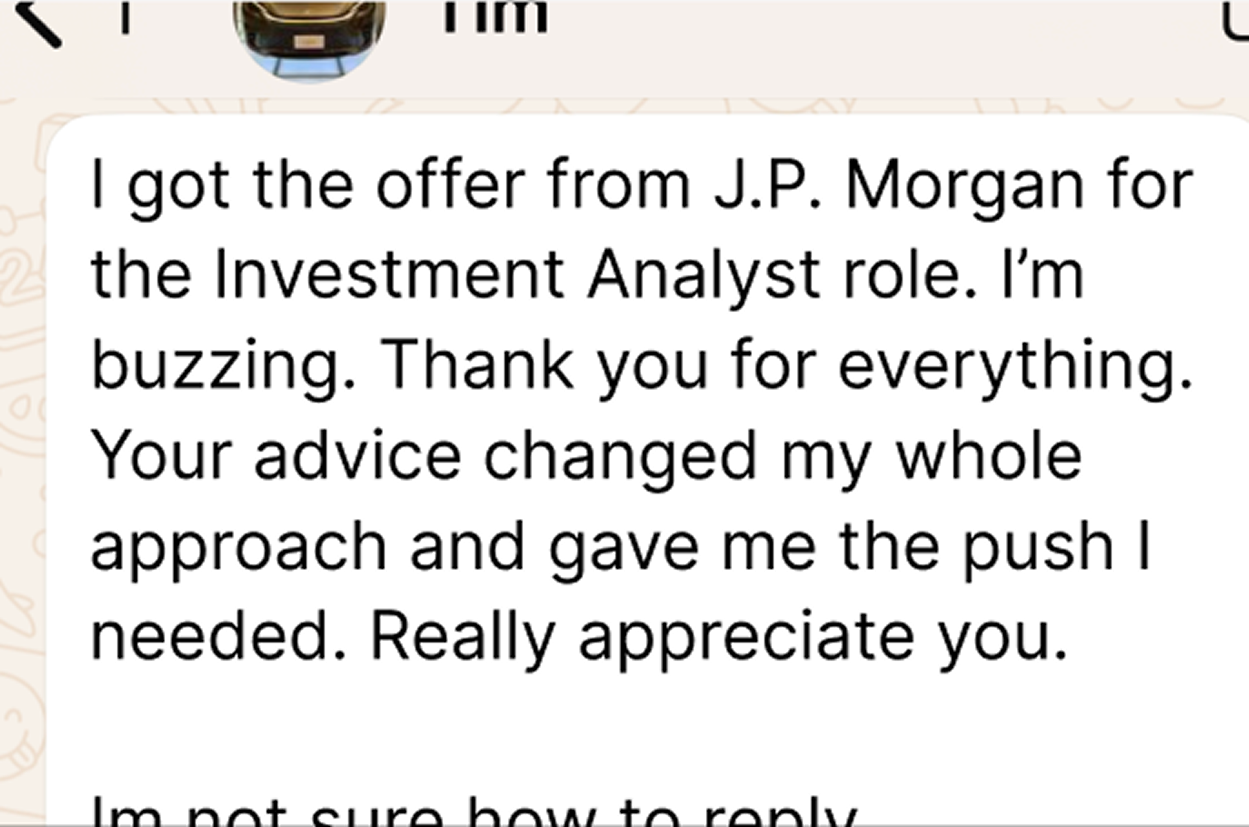
Tim is one of hundreds of candidates inside the free community working on HSBC and Tier 1 summer internship applications right now. Join them for free.
Related guides
- HSBC Summer Internship application process (full vault guide)
- Citi Spring Week 2026 application guide
- BlackRock Virtual Cover Letter: questions and how to pass
Start preparing now
If you are applying to the HSBC summer internship and other Tier 1 finance internships, the fix is rarely one more rewritten CV. It is your entire approach across the 4 stages. Join the free community with hundreds of other candidates working on HSBC and Tier 1 summer internship applications right now. Join for free.
Frequently Asked Questions
When does the HSBC summer internship open for applications?
Applications for the HSBC summer internship typically open in August or September of the previous calendar year and close on a rolling basis once divisions reach capacity. For the 2026 summer cohort, applications opened in late summer 2025. Apply as early as possible, since rolling deadlines mean later applicants compete for fewer spots.
How long is the HSBC Online Immersive Assessment?
The HSBC Online Immersive Assessment has 38 questions across 5 sections and is untimed, but most candidates take between 1.5 and 2 hours to complete it. You will need a calculator, pen, and paper. The assessment combines situational judgement questions (rank 5 responses from most to least likely) and cognitive reasoning questions covering numerical, verbal, and inductive reasoning.
What is the HSBC summer internship video interview like?
The HSBC video stage is part of a job simulation, not a standard HireVue. You are given workplace scenarios and asked to record video responses of 3 to 5 minutes each. You also complete written responses, such as advisory emails or short essays based on business cases. The format tests both your commercial awareness and your ability to structure an argument under time pressure.
What does the HSBC assessment centre involve?
The HSBC assessment centre is half a day, usually starting around 7am or 8am. It includes a 1-hour written assessment and three interviews: a competency-based interview, a technical interview, and a business-specific interview on HSBC's strategy and your chosen division. Interviews are often conducted by Vice Presidents or Managing Directors and last around 30 minutes each.
Which HSBC division should I apply to?
HSBC's main divisions for the summer internship are Global Banking & Markets, Wealth & Personal Banking, Commercial Banking, and Digital Business Services. Pick the division that genuinely matches your background and interests, since HSBC will assess fit at every stage. Generic applications that try to cover multiple divisions get filtered out early.