Barclays Spring Week 2026: How to Apply and Get In
Key Takeaways
- The Barclays Spring Week application has 3 stages: online application with a CV, psychometric tests (SJT and numerical reasoning), and a HireVue video interview
- The total timeline is around 5 to 6 weeks from submitting your application to receiving a decision
- Every stage is scored against Barclays' RISES values: Respect, Integrity, Service, Excellence, Stewardship. The HireVue is explicitly designed around them
- The numerical reasoning test draws on 6 to 8 data sources per question, which is more than most Tier 1 bank assessments. Identifying the correct data is the harder skill, not the calculation itself
- The HireVue has 6 competency questions with 2 minutes per answer, all mapped to RISES. Reflection at the end of each answer is the single highest-scoring signal
- Applications typically open in September and close on a rolling basis. Submitting early is a meaningful advantage because Barclays reviews on a rolling basis
The Barclays Spring Week is one of the most competitive first-year programmes in UK finance, and the screening rules are different from most Tier 1 banks. Barclays does not run a standard CCARR-style competency interview. Every stage is mapped to their RISES values framework, and answers that ignore that framework rarely make it past the HireVue.
This guide breaks down every stage of the Barclays spring week application process, the exact tests and questions used, and how to align your answers to the RISES values that decide most offers.
Key facts
| Detail | Info |
|---|---|
| Programme | Barclays Spring Internship (Spring Week) |
| Duration | 1 week |
| Location | Barclays UK offices including London, Glasgow, Manchester |
| Eligibility | First-year candidates on a 3-year degree, second-year on a 4-year degree |
| Stages | Online application, psychometric tests, HireVue video interview |
| Total timeline | 5 to 6 weeks |
| Divisions | Investment Banking, Markets, Research, Operations, Technology, Risk |
Barclays spring week application process
The process has 3 stages. The full timeline from submitting your application to receiving a decision is around 5 to 6 weeks.
| Stage | What happens | Typical timeline |
|---|---|---|
| 1. Online application | CV upload + application form questions | 1 to 2 weeks for response |
| 2. Psychometric tests | Situational judgement test + numerical reasoning test | 2 to 3 weeks total |
| 3. HireVue interview | 6 competency questions, 2 minutes per answer | 2 to 3 weeks for decision |
Stage 1: Online application
You submit a CV and complete an application form. Barclays does not require a separate cover letter, which means your CV and application form answers carry the full weight of the screening.
Your CV must be tailored to the banking and finance industry. Generic CVs fail at this stage more often than candidates expect. Barclays is screening for relevance, structure, and quantifiable evidence. Anything that looks like a cut-and-paste from a careers service template gets filtered out.
How to approach this:
- Lead with quantified achievements, not responsibilities. "Built a financial model in Excel that forecast society revenue for a 6-month event programme" beats "responsible for finance" every time
- Cut anything pre-A-level. The CV should be 1 page, banking format, with education at the top, work experience next, then skills and extracurriculars
- Include any banking, finance, or analytical experience explicitly. Investment society membership, trading simulations, case competitions, internships at smaller firms, all of these signal genuine interest before you have written a word in the application form
- Match the language Barclays uses on its careers site. If they describe their analysts as "commercially aware", make sure that phrasing appears somewhere in your CV with evidence behind it
- Apply early. Barclays reviews on a rolling basis and the bar rises as the deadline approaches. The same CV submitted in September is more likely to progress than the same CV submitted in November
After submitting, expect a wait of 1 to 2 weeks before hearing about the next stage.
Stage 2: Psychometric tests
After the application is reviewed, you receive an invitation to complete two online assessments. Both must be finished within a set deadline.
Situational Judgement Test (SJT)
The SJT is built directly around Barclays' RISES values: Respect, Integrity, Service, Excellence, Stewardship. You are presented with workplace scenarios and asked to rank response options from most to least effective.
Example scenario: A team member is falling behind on a project deadline. You are given 4 possible responses and must rank them in order of effectiveness, from most appropriate to least appropriate.
The "best" answer is almost always the one that demonstrates collaboration, integrity, and proactive problem-solving while staying inside Barclays' values framework. Any answer that prioritises individual performance over team outcome is usually wrong.
Numerical reasoning test
The numerical test is harder than most Tier 1 bank assessments because it presents you with data from video and written scenarios at the same time, and asks you to perform calculations and draw conclusions.
Each question draws on 6 to 8 data sources, including tables, charts, and graphs. The hardest part is not the calculation. It is identifying which 2 or 3 of those data sources you actually need.
Typical questions involve percentage increases, comparisons between time periods, ratio analysis, and trend interpretation.
How to prepare:
- Familiarise yourself with the RISES values and what each one looks like in a real workplace situation. Respect is about how you treat colleagues. Integrity is doing the right thing when it is not easy. Service is putting clients first. Excellence is high standards on detail. Stewardship is acting responsibly with the firm's resources and reputation
- Practise SJT scenarios under timed conditions on JobTestPrep or a similar platform. The Barclays SJT format is consistent year to year
- For numerical, practise with multi-source datasets specifically. Most free practice tests give you 1 chart per question. Barclays gives you 6 to 8. Get used to scanning quickly and rejecting irrelevant data
- Brush up on percentages, ratios, and reading complex tables. Speed matters as much as accuracy
- If you are unsure on a question, make an educated guess and move on. Leaving answers blank is worse than guessing
Hundreds of candidates inside the free community are working on Barclays and Tier 1 spring week applications right now. Join them for free.
Stage 3: HireVue video interview
The Barclays HireVue is a recorded video interview with 6 competency-based questions. You have 2 minutes to record each answer. Every question is mapped back to one or more of the RISES values.
This is where most candidates lose the offer. They prepare strong CCARR-style answers but forget to anchor the answer back to the value being assessed. Barclays' HireVue scoring system is explicitly tied to RISES, and the difference between a passing and failing answer is often whether you named the relevant value or demonstrated it clearly.
Questions you might be asked:
- "Tell me about a time you disagreed with a teammate. How did you handle it?" (Respect)
- "Describe a time you had to do the right thing when it was not the easiest option." (Integrity)
- "Tell me about a time you went out of your way to help a customer or colleague." (Service)
- "Describe a project where you held yourself to a high standard. What was the outcome?" (Excellence)
- "Tell me about a time you took responsibility for a mistake or a difficult decision." (Stewardship)
- "Why Barclays, and why this division?"
- "What does commercial awareness mean to you, and can you give an example?"
How to answer each question:
- Build a table before you record. Map at least one strong example to each of the 5 RISES values. That way, no matter which question comes up, you have a story already prepared
- Use the STAR method to structure every answer: Situation, Task, Action, Result
- Add a reflection sentence at the end of each answer. This is the single highest-scoring signal you can give. Most candidates skip it. Something like "Looking back, I would have escalated to my manager earlier, which is the approach I took on the next project" tells the interviewer you are self-aware and you learn from experience
- Keep answers to 90 to 120 seconds. Anything shorter feels thin. Anything longer drifts. The 2-minute cap is a feature, not a constraint
- Speak conversationally. Read the question, take 30 seconds to think, then talk. Reading from notes is obvious on camera and Barclays' reviewers actively penalise it
- Dress professionally and ensure your recording space is quiet, well-lit, and uncluttered. Test your microphone and camera before you start
- Record yourself practising and review the footage. You will spot filler words, pacing issues, and weak eye contact that you can fix before the real recording
After the HireVue, expect a wait of 2 to 3 weeks before receiving an offer or feedback.
What Barclays actually looks for at the spring week stage
Across all 3 stages, Barclays is screening for a consistent set of attributes:
- Cultural alignment with RISES. Can you naturally demonstrate Respect, Integrity, Service, Excellence, and Stewardship in real situations from your background?
- Commercial awareness. Do you understand what Barclays does, what makes it different from other Tier 1 banks, and what is happening in the market right now?
- Numerical confidence under pressure. Can you handle multi-source data quickly without panicking?
- Self-awareness. Can you reflect on your own experiences and articulate what you learned?
- Communication clarity. Can you take a complex story and explain it in 90 seconds without losing the listener?
You are not expected to be technical. The Barclays spring week is designed for first-year candidates who are exploring whether banking is right for them. Barclays is not testing what you know about valuation or accounting. They are testing how you think and whether you can communicate.
Common mistakes to avoid
- Ignoring the RISES values in the HireVue. Generic STAR answers without a values anchor are the most common reason candidates fail this stage. Every answer should make it obvious which RISES value you are demonstrating
- Treating the SJT as an afterthought. Many candidates prepare for the numerical test and skim the SJT. Barclays' SJT is directly tied to their values framework, and a weak score here can sink an otherwise strong application
- Submitting a generic CV. "Strong analytical skills" tells Barclays nothing. Replace with specific examples: "Built financial models in Excel for a society of 200+ members, increasing event revenue by 30% year on year"
- Skipping the reflection sentence. Adding "what I learned" or "what I would do differently" at the end of each HireVue answer signals self-awareness, which is exactly what the reviewer is scoring you on
- Applying late. Barclays reviews on a rolling basis. The same application submitted in September is much more likely to progress than the same application submitted in November
- Reading from notes during the HireVue. It is obvious on camera. Practise out loud until your stories flow without prompts
Proof it works
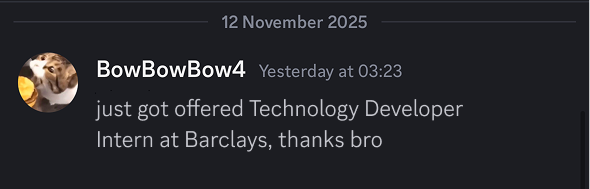
Stephen is one of hundreds of candidates inside the free community working on Barclays and Tier 1 spring week applications right now. Join them for free.
Related guides
- Citi Spring Week 2026 application guide
- Goldman Sachs Spring Week application process
- Barclays Spring Intern application process (full vault guide)
Start preparing now
If you are applying to Barclays, Citi, J.P. Morgan, or any other Tier 1 bank and not hearing back, the problem is rarely one application. It is your entire approach. Join the free community with hundreds of other candidates working on Barclays and Tier 1 spring week applications right now. Join for free.
Frequently Asked Questions
What is the Barclays Spring Week?
The Barclays Spring Week is a 1-week internship programme for first-year candidates on a 3-year degree, or second-year candidates on a 4-year degree. It gives you direct exposure to Barclays' divisions including Investment Banking, Markets, Research, Operations, Technology, and Risk. Successful candidates are typically fast-tracked into the Summer Internship the following year.
What stages does the Barclays Spring Week application process have?
The Barclays Spring Week application has 3 stages: an online application with a CV upload, psychometric tests covering situational judgement and numerical reasoning, and a HireVue video interview with 6 competency-based questions. The full timeline from application to decision is around 5 to 6 weeks.
What are the Barclays RISES values?
RISES stands for Respect, Integrity, Service, Excellence, and Stewardship. Every stage of the Barclays application process is scored against these 5 values. The situational judgement test ranks responses by how well they reflect RISES, and the HireVue questions are explicitly designed around the values. Aligning your answers to RISES is the single biggest factor in passing the HireVue stage.
What questions does Barclays ask in the HireVue interview?
The Barclays HireVue has 6 competency-based questions with 2 minutes per answer. Common questions include "Tell me about a time you disagreed with a teammate", "Describe a time you held yourself to a high standard", and "Why Barclays?". Every question maps to one or more of the RISES values, so anchor each answer to the relevant value and add a reflection sentence at the end.
When do Barclays Spring Week applications open and close?
Barclays Spring Week applications typically open in September each year and close on a rolling basis once divisions reach capacity. Applying in the first 2 to 4 weeks after the cycle opens gives you a meaningful advantage, since Barclays reviews on a rolling basis and the bar rises as the deadline approaches.